What is a standard Copper Vapor chamber?A standard copper vapor chamber is constructed from sealed copper sheets, the joints are joined by brazing or diffusion bonding, and filled with a small amount of fluid such as purified water that allows heat to be rapidly dispersed away from the heat source, many fluids can be used as the working fluid of the vapor chambers, but in most CPU, GPU and LED cooling applications, water is choosed as the working fluid, because of its high latent heat, high surface tension, high thermal conductivity and suitable boiling temperature, low cost and environmental protection.Inside a vapor chamber there are small copper columns to prevent buckling of chamber walls.And the wick structure is a must in vapor chamber to provide capillary force, the wick structure can be made of many different substances, the most common way is to sinter copper powder to the inside walls of the vapor chamber.
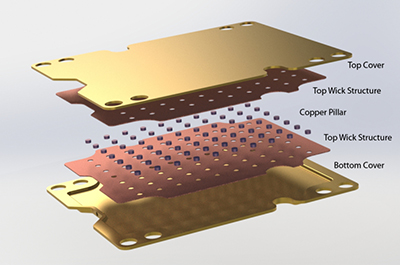 How the Vapor Chamber works?With very low pressure inside the vapor chamber,the fluid will be boiled and vaporized at a much lower temperature than its normal boiling temperature. When heat is applied to the vapor chamber, the fluid near that location immediately vaporizes and rushes to fill the entire volume of the chamber (driven by pressure difference). When the vapor comes into contact with a cooler wall surface, it condenses, and releases its latent heat of vaporization. The condensed fluid returns to the heat source by capillary force of the wick structure. The recycling of evaporating and condensing form a pumping action to move the heat from heat source area to all other areas of the vapor chamber, resulting in a uniform temperature distribution on vapor chamber's surface.
 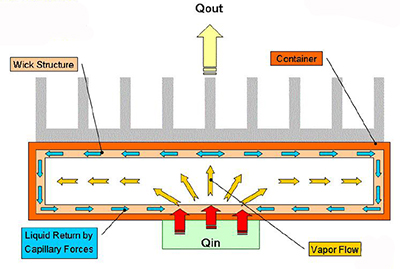 The benefits of using a Vapor Chamber
Vapor chambers, like heat pipes, do not actually dissipate the heat to the environment, so it can not instead of heatsinks,but serve to move heat efficiently within a thermal system, the effective thermal conductivity of vapor chambers is usually 5 to 100 times the conductivity of copper, so Vapor chamber is one of the best heat transfer option at the base of a heatsink,a properly designed vapor chamber combined with a stamped fin heatsink can improve the thermal performance by 30% over copper and heat pipe based solutions.
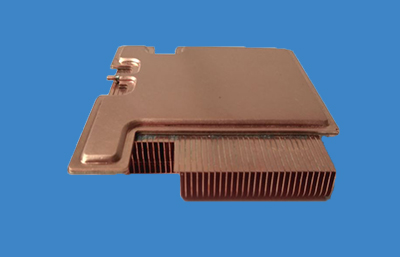
In addition, a vapor chamber is much lighter than solid copper, due to its internal chamber structure, with the same weight of extruded aluminum heatsink, it works much better than a copper heatsink. In some cases with more space constraints, the use of vapor chamber will be more effective than other designs with the same space size.
Vapor chambers have proven to be robust and reliable over many years in computer applications which have high TDP in a small area, such as processors, graphics cards and other chip-sets, Vapor chamber have excellent permafnce by transporting large heat loads from small areas with very little temperature difference.Reliability of a Vapor Chamber
Like heat pipes, vapor chambers are very reliable thermal devices. They do not have any moving parts or use any corrosive materials. The working fluid and wick structures are permanently sealed in a copper vessel.
The following tests are routinely performed to confirm the durability and reliability of vapor chambers:
Thermal Shock Test
Accelerated Life Test
Freeze Thaw Test
Burst Test
Cosmetic Degradation TestHow to use a vapor chamber?
In many applications, the decision to use a vapor chamber is frequently compared to a thermal solution using heat pipes,the main aspects of applications that differentiate vapor chambers from heat pipes are high power density and high power, once heatpipe can not meet your perfermance demand, or there are some constraints when use heatpipe, you can try vapor chamber.
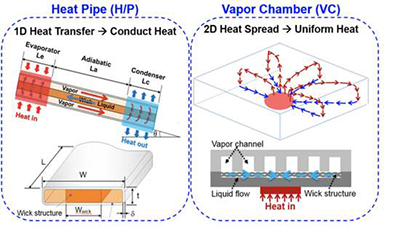
Vapor chamber can be integrated with either aluminum or copper heatsinks. The simplest method is to solder a vapor chamber to the base of an extruded heatsink. A more thermally efficient method is to solder a stack of stamped fins directly to the surface of a vapor chamber. To improve the dimensional integrity, these fins are often interconnected by locking tabs called zipper fins.How to design a vapor chamber?
The return of fluid to its boiling location is primarily driven by the capillary force, but gravity and centrifugal force can also contribute to some degree. To utilize the external forces, it is important to design the vapor chamber, such that the gravity or centrifugal force, is working in the direction that drives the fluid from its cold side to the hot side.
A thicker and big vapor chamber can transport more vapor and heat, if there is enough space, a thicker and bigger can get a high Q-max and lower thermal resistance.
The following table shows the suggested operation conditions for typical applications.
It is not necessarily maximize capabilities of vapor chambers when use in your application,vapor chamber provides best perfermance when its capabilities just match your demand, please contact us if you have any questions when design a vapor chamber.
| Vapor Chamber Ambient temperature |
0 - 85 ºC |
| Power |
20 - 300 W |
| Heat Flux |
Up to 300 W/cm2 |
| Size (width and length) |
50 to 200 mm |
| Vapor Chamber Thickness |
2 mm and up |
| Vapor Chamber Flatness |
0.1 mm in every 25x25 mm area |
| Vapor Chamber Life (MTBF) |
80000 hours |
| Through Holes |
Allowed |
| Thermal cycling |
Tested 200 cycles between -40 and 85 ºC |


