What is a heatpipe?A Heatpipe is a sealed copper tube that is under vacuum, and filled with a small amount of fluid such as purified water that allows heat to be rapidly dispersed away from the heat source. The high thermal conductivity enables a heat pipe to transfer and dissipate heat to a more convenient location through a capillary action. Heat pipes do not actually dissipate the heat to the environment, but serve to move heat efficiently within a thermal system. Heat pipes are available in various shapes and sizes. It can be flat or round, and can be formed to fit most structure.How the heatpipe works?When heat is applied to the heatpipe, the fluid near that location immediately vaporizes and rushes to fill the entire volume of the pipe (driven by pressure difference). When the vapor comes into contact with a cooler wall surface, it condenses, and releases its latent heat of vapor. The condensed fluid returns to the heat source by capillary force of the wick structure. The recycling of evaporating and condensing form a pumping action to move the heat from heat source area to all other areas of the heat pipe, resulting in a uniform temperature distribution on heatpipe's surface. 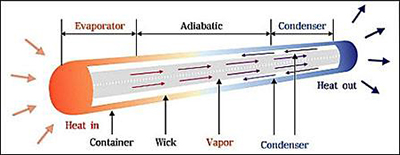 Heatpipe usesThe use of a heatpipe for thermal management is a proven and widely applied technology. The modern concept of a capillary driven heat pipe was first invented by General Motors in 1962. NASA later adapted and further developed this concept. Heatpipes have become common place in some of today’s electronics systems. Computers, pipes along the Trans-Alaska Pipeline, nuclear reactors, heat-sensitive electronics aboard satellites and the International Space Station, all rely on heat pipes to manage thermal output effectively.
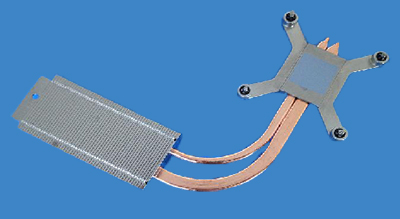
Heatpipe contruction
A heat pipe is constructed using a copper tube that is sealed under a partial vacuum.
Inside the copper heatpipe is an inner wick lining that acts as a capillary material for a small amount of fluid.
There are 4 types as most common inner wick of heatpipe, list as blow, customer can choose base on demand:
Grooved - Low Cost, does not work well against gravity
Wire Mesh - Middle cost and permance
Sintered - Most common method,higher cost and permance
Composite - Highest performance and cost.
As to fluid, many fluids can be used in heatpipes as the phase transition. In most applications, purified water is selected as the working fluid due to its high latent heat, surface tension, thermal conductivity and boiling temperature. The negative pressure of the vacuum within heat pipes allows the water to boil and vaporize at lower temperatures than normal.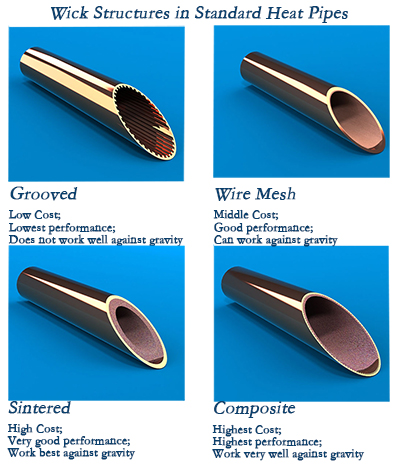 How to design a heatpipe?
Standard heat pipes can be bent in a variety of directions, inserted into finned heat sinks, or press-fitted into thermal module components for better surface contact with heat sources. The heatpipe can also be flattened to ensure more contact surface area with thermal interface materials.Different shape and thickness will affect the performance of the heatpipe. And while the heat pipe's wick structure type can affect the efficiency of the heat pipe at various orientations.
Due to the highly customizable nature of heat pipe design, please contact Thermsolver for a custom design that fits your thermal management needs.
The table below is a representation of Thermsolver's standard manufacturing capability.
| Diameter(mm) |
Length(mm) |
Pipe Wall Thickness(mm) |
Minimum Thickness(mm) |
| 3 – 16 |
80 – 600 |
0.20 – 1.0 |
1.2 |


